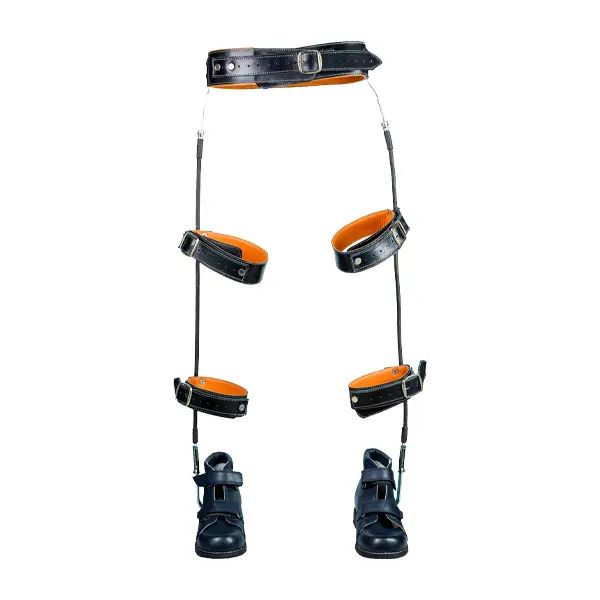
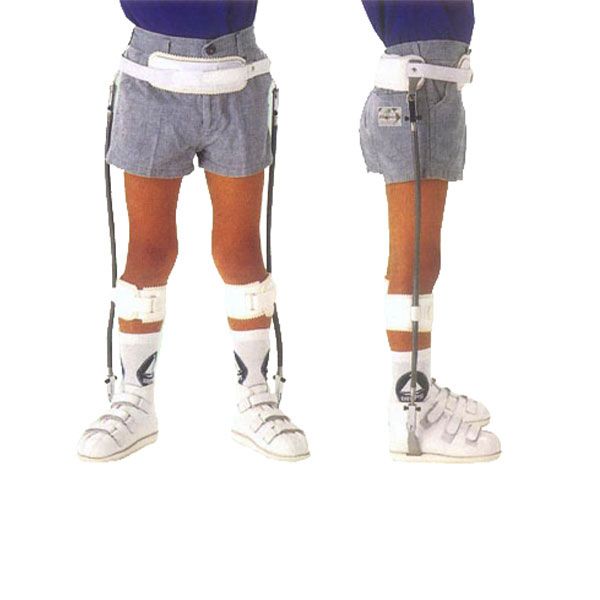
A Torsion Twister Cable Orthosis (sometimes called a twister cable orthosis or torsion cable orthosis) is a type of lower-limb orthotic device used mainly in children to help correct rotational deformities of the legs—especially internal tibial torsion, femoral anteversion, or in-toeing gait.
✅ What It Is:
A Torsion Twister Cable Orthosis is an external device made of:
- A pelvic/waist belt
- Two thigh or leg cuffs
- Torsion cables connecting the cuffs and belt
These cables apply a rotational (twisting) force to encourage the legs to rotate into a more normal alignment during walking.
✅ What It’s Used For:
It is typically prescribed for:
- Internal tibial torsion
- Femoral anteversion
- In-toeing gait
- Gait training in children with neuromotor conditions (e.g., mild cerebral palsy)
Usually used in children aged 3–8 years, when the bones and gait patterns are still highly adaptable.
✅ How It Works:
The orthosis uses spring-loaded or tensioned cables that:
- Apply a controlled external rotation force to the legs when the child walks.
- Gradually retrain correct rotational alignment.
- Encourage correct hip–knee–foot orientation during gait.
- It does not force the legs, but gently guides them during movement.
✅ Advantages:
- Lightweight and adjustable
- Can be worn over clothes
- Encourages correction during natural walking
- Often better tolerated than rigid braces
❗ Limitations:
- Works best in mild–moderate cases
- Requires consistent wearing for months
- Not effective in severe bony deformities
- Compliance can be difficult for some children
